Fantasy tips: captain logic, differential picks, role balance, salary cap
The fantasy tips desk covers the captain logic that compounds across a season, the differential-pick framework, role balance, and the salary-cap math that wins small contests.
This desk is for users who have built a few XIs and want to sharpen their reads. It assumes you understand the basic loop and want to push your win rate up. We do not cover absolute basics -- see /fantasy-cricket/ for the loop and /how-to-play/ for the steps.

The single biggest decision
Captain gets 2x points. Vice-captain gets 1.5x. Together, they account for 30-40 percent of your XI total in a typical contest. Captain pick is the single biggest decision you make before lock-in.
Three lenses for captain pick:
- Form. In-form batter or bowler with three or more consecutive strong performances.
- Fixture. Opposition weakness at the role. A leg-spinner on a turning pitch against left-handed batters.
- Role. All-rounders are captain magnets because their points span batting and bowling.
The captain pick framework compounds across a season. The user who picks captains well wins 5-10 percent more contests than the user who picks XIs well but captains badly.

Win small contests by being right when the field is wrong
Differential picking means selecting players the field is underrating. In a 100-player Rs 1 contest, a captain pick that 5 percent of users picked who fires gives you a 20-place jump. The math flips as the field grows: in a 10000-player grand league, the same differential who fires gives you a 500-place jump.
The differential framework:
- Recency bias. If a player has had one hot match, the field has caught up. Look for two-match recency instead.
- Role-change signal. A batter promoted up the order, a bowler given the death overs, a fielder moved to a catching position.
- Pitch-match signal. A spinner on a dry pitch, a pace bowler on a green track.
How to fit 11 players in 100 credits
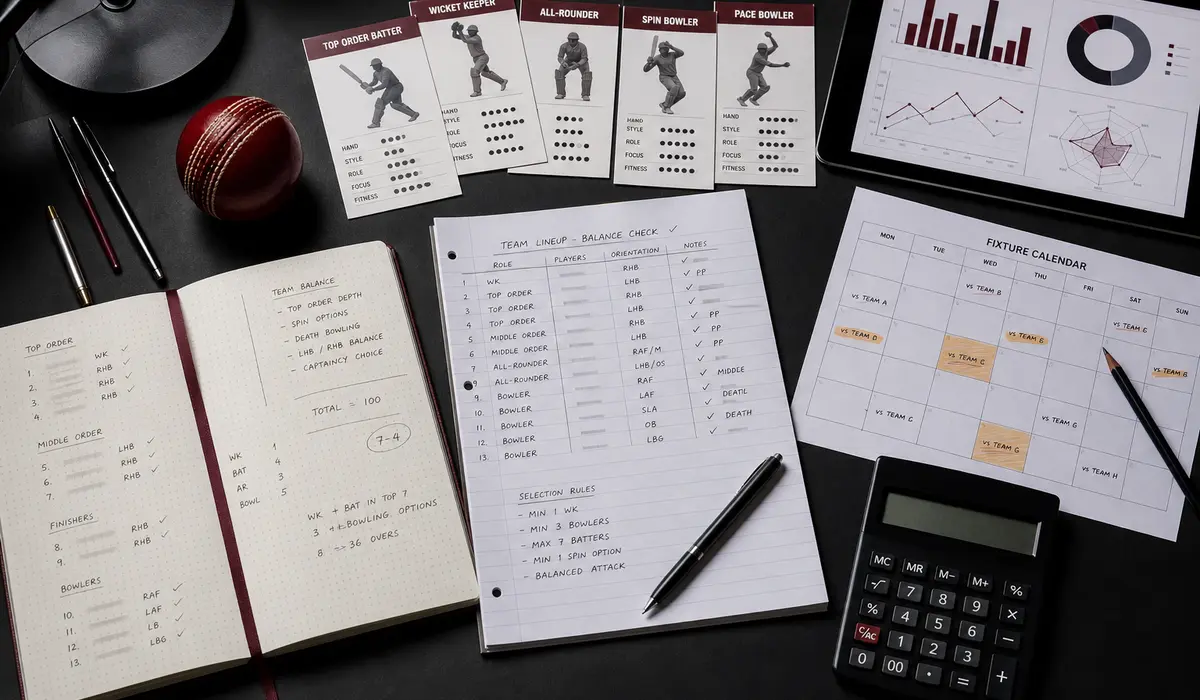
The salary cap forces trade-offs. The optimal XI balances roles:
- 1 wicketkeeper-batter. Dual-credit player. Required by the rules.
- 3-5 batters. Including the wicketkeeper. Top-order batters cost more; middle-order batters cost less.
- 1-3 all-rounders. The most credit-efficient role. Each all-rounder replaces one batter and one bowler in your XI.
- 3-5 bowlers. Mix of pace and spin. Death-overs bowlers cost more.
Common pitfall: stacking all-rounders in pursuit of value, then running out of credit for a frontline pacer. The fix is two all-rounders max in most contests.
Credit allocation across roles
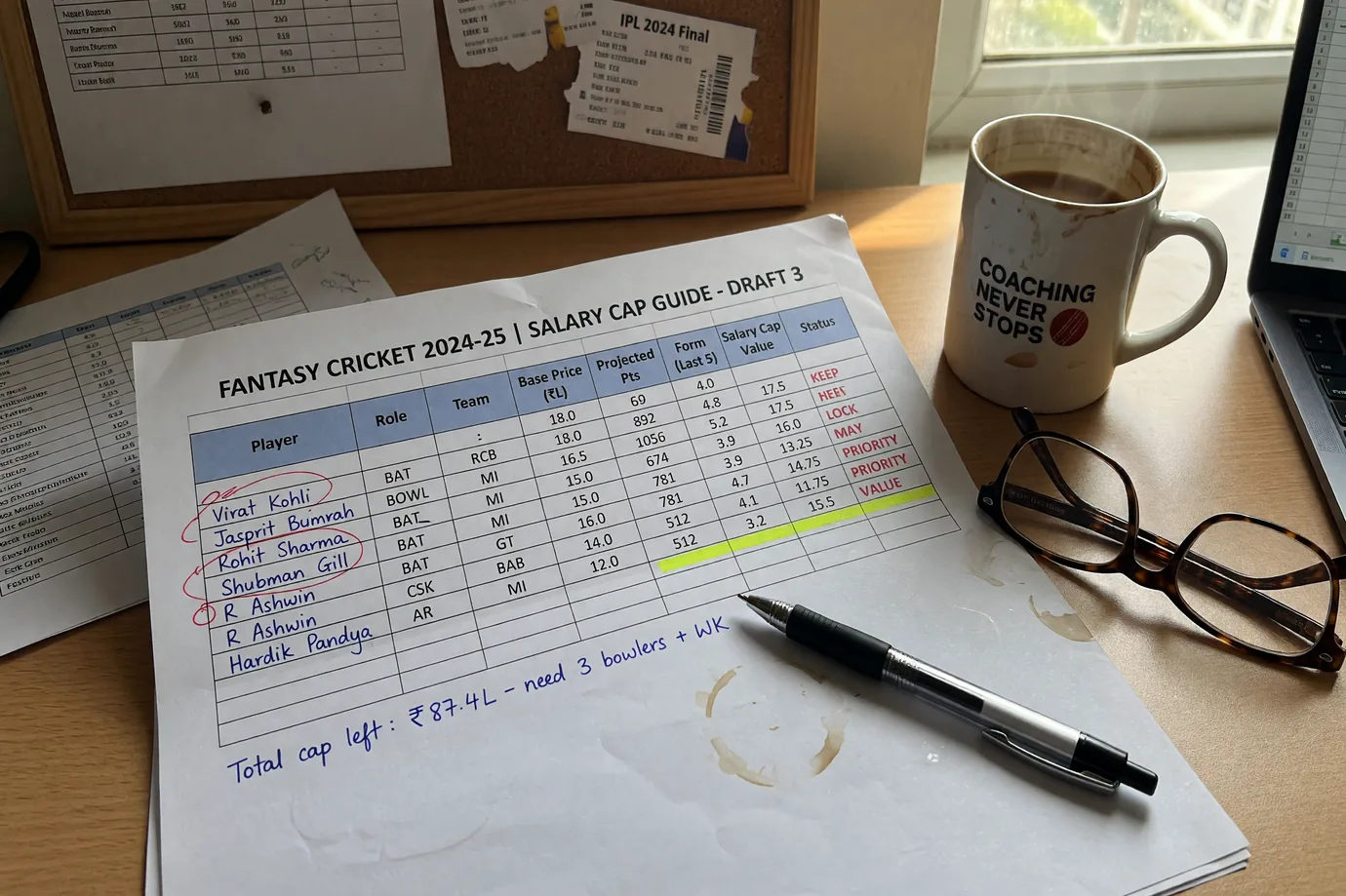
The 100-credit cap forces allocation across roles. A typical distribution:
| Role | Count | Average credit | Total |
|---|---|---|---|
| Wicketkeeper-batter | 1 | 9 | 9 |
| Batter | 4 | 9 | 36 |
| All-rounder | 2 | 9.5 | 19 |
| Bowler | 4 | 9 | 36 |
| Total | 11 | 100 |
The exact distribution depends on the match. Spinner-friendly pitches tilt credit toward spinners. Death-overs matches tilt credit toward death-overs bowlers.
Cross-reference form, fixture, venue
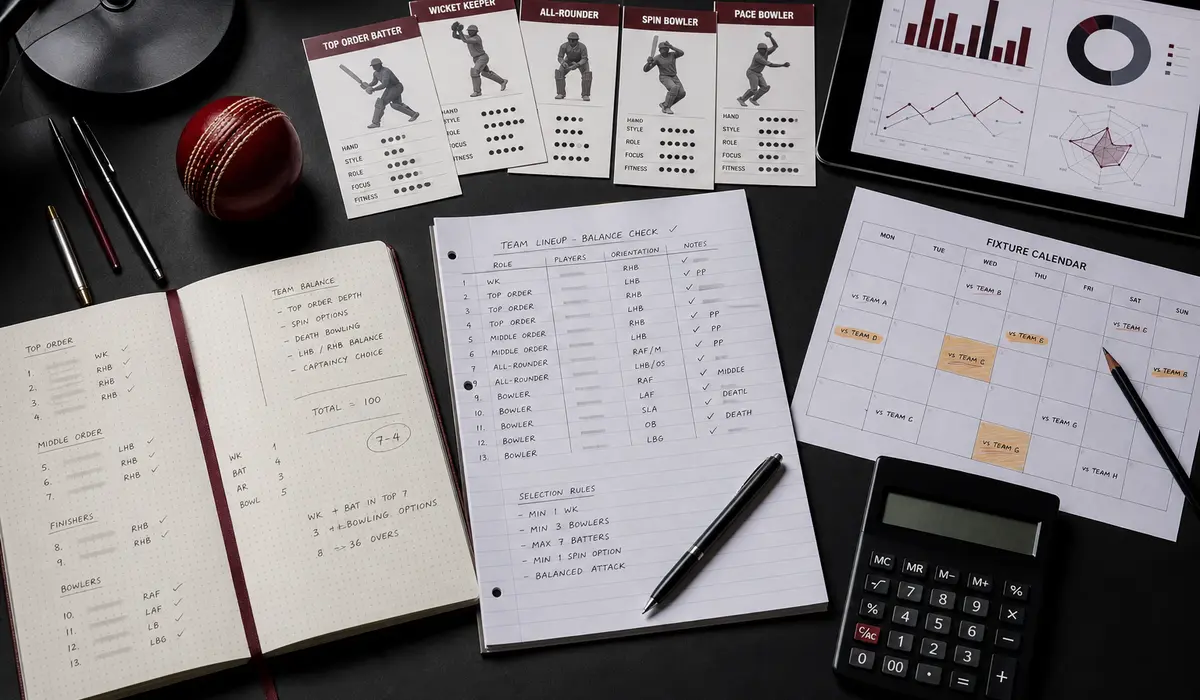
Match-up reading is the application of all four lenses to a single player in a single match. Three steps:
- Player form. Last-five-match average points in the relevant role.
- Opposition weakness. Where does the opposition concede points? Pace in powerplay? Spin in middle overs? Death-overs wickets?
- Venue & weather. Pitch and dew adjust the expected scoring rate.
If all three align (form + match-up + venue), the player is a captain candidate. If only two align, the player is a vice-captain candidate. If only one aligns, the player is a bench candidate.

Recent editorial on this desk
Questions readers actually ask
What is the best captain pick strategy?
Captain the player whose form, fixture, and venue all align. Three-aligned is captain; two-aligned is vice-captain; one-aligned is bench.
How many all-rounders should I pick?
Two all-rounders is the typical optimum. Three works in spinner-friendly matches with all-rounders who bat top-order. Four leaves no credit for a frontline pacer.
When should I pick a differential captain?
In small Rs 1 contests (field under 200 players), differential captain wins more often. In grand leagues (field over 5000 players), favourite captain is more rational.
How do I read form?
Last-five-match average points, not career average. Form is what the player is doing now; reputation is what they did last season.
Sharpen your captain pick
Apply the captain pick framework to the next IPL match. Open the app, build an XI, and pick captain and vice-captain with the three-aligned rule.